

The historical background of musical instruments, their roots, their development, and their spread are often very exciting stories. They usually involve cultural roots, creativity, innovation, and their expression in sound, rhythm, and music.
Music is one of humanity’s most universal languages. It connects without words and awakens feelings beyond intellectual, linguistic understanding.
Plato summed it up well: “Music gives a soul to the universe, wings to the mind, flight to the imagination, and life to everything.” And the tools for this magic are, in addition to the voice, the diverse musical instruments.
Here, we will attempt to stimulate reflection using three musical instruments that are connected in various ways. To reflect on the difference between creation, development, and design. But also on what cultural appropriation is in contrast to cultural development.
By comparing and highlighting their connections to each other, these three instruments, the HANG & the HANDPAN, the STEELPAN and the TASSA, could help to trigger these hoped-for thought-provoking impulses and, in the best case, even give rise to new insights.
On origin, development, design and the question of cultural appropriation

While the TASSA undoubtedly ‘simply appeared’ in Persia in the 11th century and later established itself in India and much later in Trinidad and Tobago, the situation is quite different for the STEELPAN, the HANG, and the HANDPAN.

The STEELPAN (The widely used term ‘Steel Drum’ is an invention. In Trinidad, no one talks about steel drums, but exclusively about SteelPans !) arose out of a cultural necessity that affected former slaves and then oppressed and underprivileged people—and above all, culturally and musically uprooted people in Trinidad. A collective developed the steel drum, which was later refined and perfected by brilliant individuals such as Elliot Mannette. Its development continues, if only because an entire culture identifies with it. However, there was no inventor, ‘only’ a collective development.
Film tip: “PAN – Our Musical Odyssey” & The History of Steel Pan in Trinidad (Youtube)

The HANG was designed. The HANG is a ‘constellation’ – a design inspired by impulses that stimulated Reto Weber. Reto Weber as the catalyst, Sabina Schärer, and Felix Rohner as those who gave form to the impulse. Weber was surprised by the richness of PANArt sound objects when he picked up his PANArt-tuned Steelpan at PANArt in Bern/Switzerland in November 1999 and brought his Ghatam with him. He realized that PANArt was capable of building spherical objects that had more to offer sonically than his Ghatam. Together, the three of them then put this idea into practice, and the ‘Urhang’ was created with Sabina Schärer’s ‘Pang bowls’. Inspired by the spherical plexus, the network of resonators in the Steelpan as described by Anthony Achong and researched by Thomas D. Rossing, and implemented using the material Pang (sheet metal treated with nitrogen) that PANArt has been developing since 1987 and later patented, the Hang was born. The assumption that the HANG is directly derived from the STEELPAN is widespread but incorrect. Its origins are clearly more linked to the Indian GHATAM. You only need to look at the two instruments and how they are played to see this clearly.
Film tip: “HANG – a discreet Revolution”

The HANDPAN (also called PANTAM) also arose out of necessity. Namely, the desire to better satisfy the exploding demand for this instrument, which the manufacturers of the HANG were unable to meet. But the HANDPAN was not invented. In the early days, it was much more an attempt to copy the HANG. There were exceptions in the pioneering days of the HANDPAN, such as Bill Brown’s CAISA or Marti’s SUNPAN, which in some cases applied different basic concepts than the HANG manufacturers at PANArt. This was followed by decisive further developments such as Jan Borren‘s HANDPAN Mutant Layout or SATYA‘s use of new materials in the manufacture of HANDPANS. The HANDPAN is not an invention, but in the worst case simply a copy of the HANG and in the best case a creative further development (mutant layout, bottom notes, various steel mixtures and alloys) of the basic concept of the HANG.
Film tip: I can’t give one because I don’t know of any serious documentaries on the subject of HANDPAN.
The HANG and HANDPAN are modern designs from Switzerland with no connection to cultural, national, or religious traditions. They have become widely popular worldwide (especially since around 2017/2018) and are played by people from all walks of life—partly because they are very easy to play (pentatonic instruments).
The STEELPAN is an essential part of Trinidad and Tobago’s musical identity and is considered the country’s national instrument. It is regarded as the only acoustic instrument invented in the 20th century and is recognized as such worldwide.
The TASSA is a bowl-shaped, conical drum of North Indian origin, also known as Taash or Taasha, with ancient Persian roots that spread to the Indian subcontinent during the Mughal migration and later dispersed globally through the Indian diaspora.
1. HANG and HANDPAN: Modern instruments inspired by the traditional instruments ghattam and Steelpan
The Hang and the Handpan are closely related instruments within a family of convex steel drums played with the hands, but they differ significantly in origin, construction, and availability. The Hang was designed in 2000 by PANArt, a Swiss company founded by Felix Rohner and Sabina Schärer, in Bern, Switzerland. This design was inspired by an idea from Reto Weber, a Swiss percussionist who played several ghattams in different pitches simultaneously. He expressed a desire for a steel ghattam with multiple notes. The name “Hang” means “hand” in the Bernese German dialect, reflecting its intended playing method. It was developed as a fusion of the Trinidadian steel pan and the Indian Ghatam, aiming to create a hand-playable instrument with rich harmonic resonance. The Hang is designed from a specialized steel alloy and features a central note called the “Ding,” surrounded by 7 or 8 tone fields arranged in a circle, with a bottom “Gu” side that can be played percussively. The instrument is trademarked by PANArt, and its production was limited and controlled, with the company ceasing production in 2014.
In contrast, the term “Handpan” is a generic descriptor for instruments inspired by the Hang, created by various manufacturers worldwide since the early 2000s. While the Hang is a specific trademarked instrument, the handpan is a broader category encompassing numerous variations in design, materials, tunings, and scales.
2. STEELPAN: Trinidad and Tobago’s National Instrument
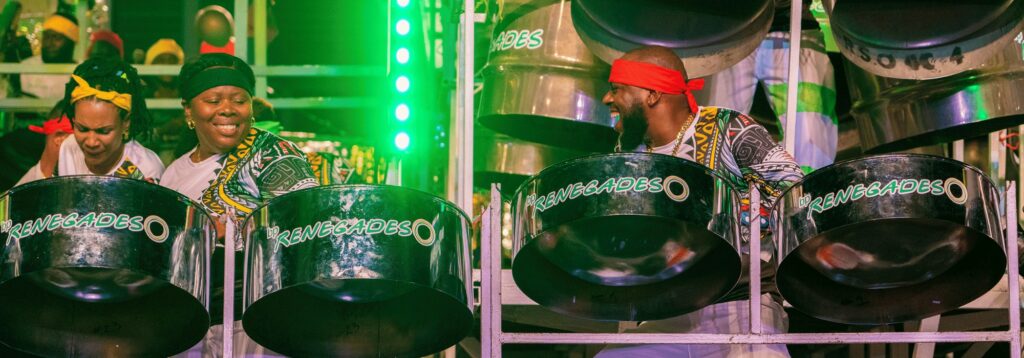
The Steelpan originated in Trinidad and Tobago during the 1930s, evolving from the Tamboo Bamboo ensembles used in Carnival celebrations after colonial authorities banned traditional African drums. Crafted from 55-gallon oil drums—originally imported but transformed locally—the steelpan is a chromatically tuned percussion instrument capable of playing full musical scales. It is widely celebrated as a uniquely Trinbagonian invention and was officially recognized as the national instrument of the country.
On July 26, 1951, the Trinidad All-SteelPan Percussion Orchestra (TASPO) performed at the Festival of Britain, marking the global debut of the steelpan. Today, it is central to Panorama, the largest steelband competition held annually during Carnival.
3. TASSA: An Persian-Indo-Caribbean Heritage Instrument
The TASSA is a high-pitched kettle drum with origins tracing back to North India and Persia, brought to Trinidad by indentured laborers in the 19th century. It became a key part of Hosay (Muharram) commemorations, weddings, and religious ceremonies within the Indo-Trinidadian community. Over time, tassa evolved into a distinct Caribbean form, incorporating local rhythms such as “dingolay” and “calypso” beats, differentiating it from its South Asian counterparts.
Tassa ensembles typically include the tassa (lead drum), dhol (bass drum), and dhantal (metal clapper). Unlike the steelpan, which uses imported oil drums, proponents argue that tassa is made entirely from local materials: clay bowls, goat or sheep skins, wild cane sticks, and mango wood for the dhol.
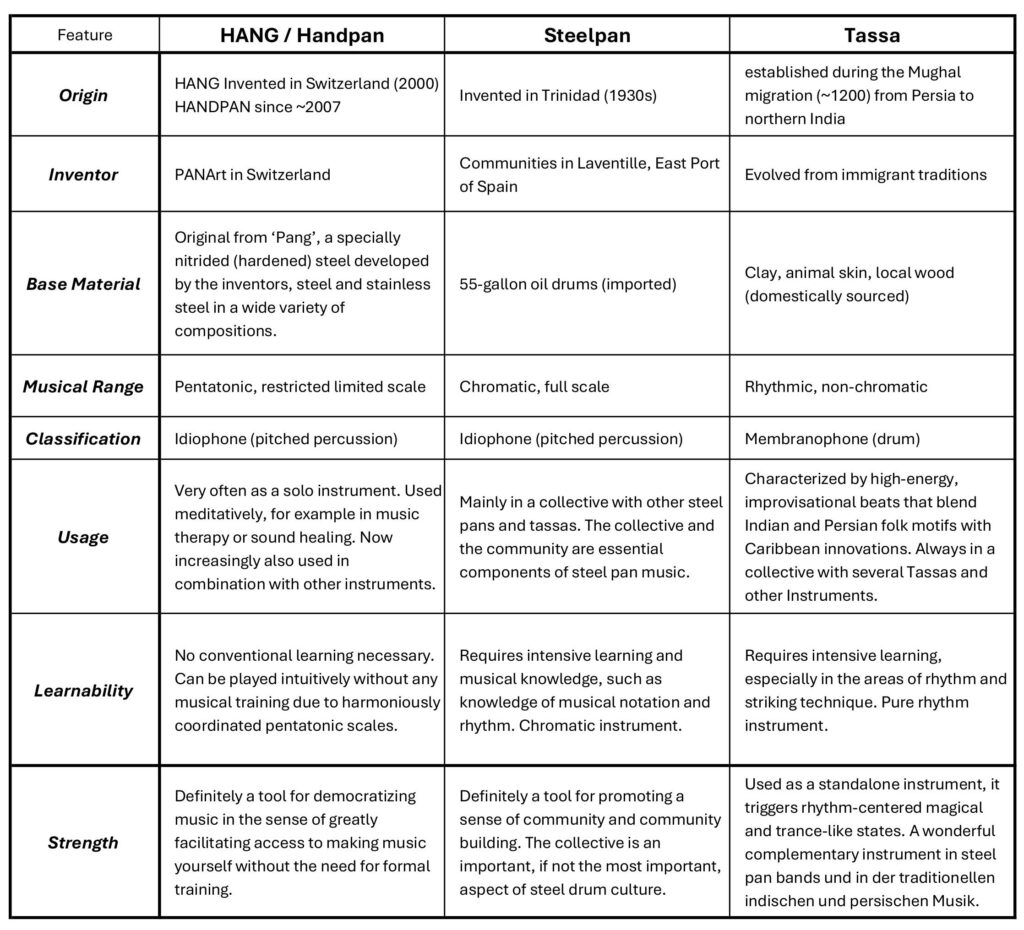
4. Comparative Origins and Materials, Usage and more
5. Cultural Significance and National Identity
The HANG and HANDPAN are not tied to any national or religious traditions and are spreading throughout all social classes and cultures worldwide. While these instruments are mainly popular in the subculture of the alternative social class in the Western world, in other cultures they are increasingly integrated into local musical traditions. Good examples of this are Persia and India.
The STEELPAN is deeply tied to Afro-Trinidadian heritage and is seen as a symbol of resistance and creativity born from colonial suppression. It is played year-round but reaches its peak during Carnival and Panorama.
The TASSA represents an ancient North Indian and Persian tradition and later an Indo-Trinidadian cultural expression and has gained broader popularity beyond religious contexts.
Just as the Persians do not consider the use of ‘their’ TASSA in India and Trinidad and Tobago to be cultural appropriation, the steel pan community of Trinidad does not consider the HANG or the HANDPAN to be cultural appropriation. All three instruments are somehow connected, but they have undergone very distinct developments.
Leave a Reply