

On June 16, 2026, the Bern Commercial Court published its eagerly awaited decision regarding the legal dispute over the “design protection” of the Hang© by PANArt.
This now-published decision was preceded by a legal battle lasting several years and spanning multiple court levels – and even this latest decision is still subject to appeal. At this time, it is impossible to predict whether an appeal will be filed, either by the plaintiff (HCU) or the defendant (PANArt), or by both. Personally, I wouldn’t be surprised if an appeal were filed. In any case, from the current perspective, this decision is a preliminary ruling, and we will likely have to wait until early August to find out whether it will be appealed.
Here you will find the official statements and comments from both parties regarding this court decision:
· HCU Plaintiffs: https://hcu.global/newsletter-june-2026/
· PANArt: https://panart.ch/en/copyright/entscheids-des-handelsgerichts-des-kantons-bern-vom-16-juni-2026
Since not everyone is necessarily interested in working through a 142-page legal document—which, moreover, requires some prior knowledge of the legal dispute to interpret properly—I will now attempt, to the best of my knowledge and belief, to summarize the essence of the ruling and present it here in a way that is accessible to everyone:
Summary of the decision by the Bern Commercial Court regarding the protection of the design of the Hang by PANArt dated June 16, 2026:
1) Background: The plaintiffs consist of 25 parties (from the Netherlands, Germany, and Switzerland) that manufacture and/or distribute so-called handpans and operate under the name HCU (Handpan Community United). The lawsuit was filed against PANArt (Switzerland, Felix Rohner, Sabina Schärer), who invented the Hang© around the turn of the millennium—and are asserting a claim to copyright protection (= “design protection”) – primarily because they view the Hang© as a designed “social sculpture” or “sound sculpture,” rather than a conventional musical instrument. The group of plaintiffs, by contrast, views the Hang© and Handpans as “modern musical instruments,” whose form cannot be protected any more than the form of other musical instruments, since, as they argued, this form is dictated by technical or functional considerations.
In July 2024, the court had already concluded that the Hang© qualifies as a copyright-protected work.
Four essential features of the Hang© were protected, namely a) the central note (the “Ding”), which is dome-shaped; b) the notes arranged in a circular pattern around it; c) the lens-shaped body of the instrument; and d) the centrally located resonance hole (the “Gu”) in the middle of the lower shell.
2) These proceedings: Seven of the original 24 plaintiffs against PANART withdrew from the proceedings and reached an out-of-court settlement with PANArt. The remaining 18 plaintiffs now sought, in these most recently decided proceedings, a judicial declaration that their handpans and activities (manufacture and trade) do not infringe PANArt’s copyrights in the Hang© (= interest in a declaratory judgment). This declaration was sought and granted with due regard to the respective national legal systems, making it valid for the Netherlands, Switzerland, and Germany (which effectively amounts to a decision valid throughout the entire EU).
3) What has now been decided: Of the approximately 250 Handpans of various designs and configurations submitted to the court by the plaintiffs, a good 200 were found to infringe PANArt’s copyrights. However, most of the instruments now classified by the court as not infringing PANArt’s copyrights were categorized by the court as “borderline cases.”
In financial terms, the Bern court quantified the success of this declaratory proceeding at approximately 95% in PANArt’s favor, as reflected in the imposition of a “penalty payment” (compensation to the opposing party + court costs) totaling approximately €175,000, which the parties to the HCU are obligated to pay.
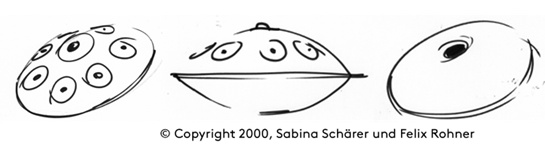
4) Conclusion or Current Status: Either party (!) may appeal this decision within 30 days. In my assessment, it is still completely unclear at this time whether one of the two parties to the proceedings will appeal this decision. The HCU, because they consider the decision too strict and would like more creative freedom in the future—or PANArt, because they want their design features protected even more strictly. As already mentioned, the court has already deemed some designs “borderline” in this decision.
This decision is a preliminary ruling, and we will likely have to wait until early August to find out whether it will be appealed.
5) Outlook and expected claims for recourse and damages that are very likely to be asserted: It’s safe to assume that PANArt will file claims for damages against major retailers and large handpan manufacturers in accordance with a final ruling as soon as a legally binding final decision is issued. I assume that PANArt’s attorneys have long had the sales figures of relevant handpan retailers on their radar and are documenting them.
The first thing that happened after the publication of this ruling was that, almost immediately, all handpan shapes that conflicted with PANArt’s now-established copyright disappeared from sales platforms.
In conclusion, here is an attempt (!) at a reasonably complete overview of handpan shapes that now infringe – or do not infringe – PANArt’s court-recognized copyrights regarding the Hang©:
A.1) Classic “8+1” or “9+1”: with the central note shaped like a dome (apex) clearly infringes PANArt’s copyright regarding the Hang©!
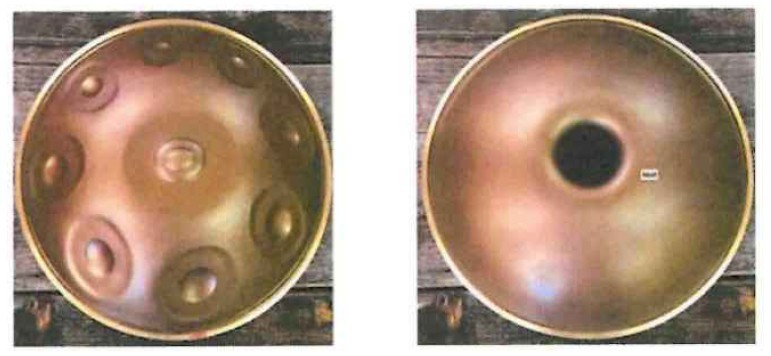
A.2) Classic layout plus bottom notes: A central note plus a circular arrangement of several tone fields plus bottom notes that are designed exclusively as indentations (impex) infringes PANArts’ copyright on the Hang©
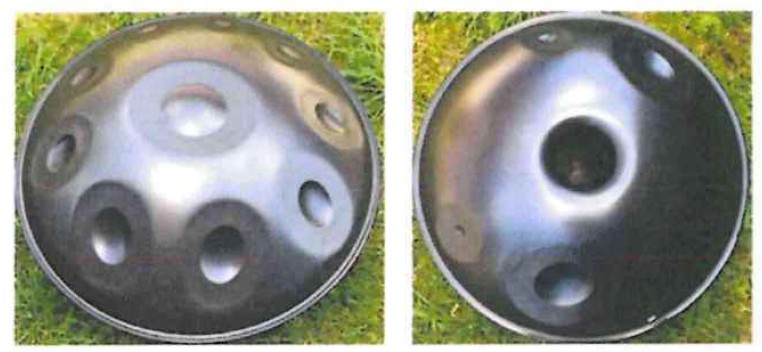
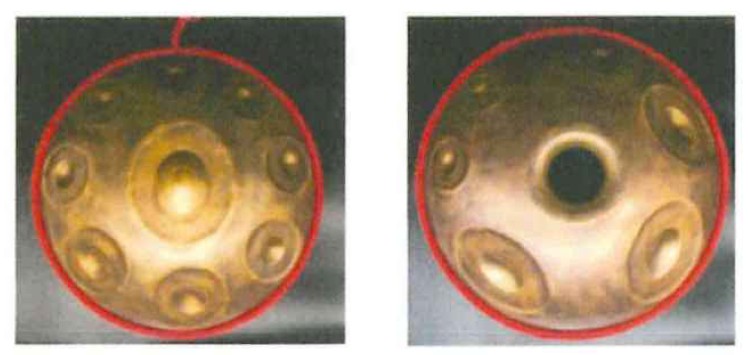
B.1) Impex Central Note: If the central note (PANArt term “DING”) is not shaped like a dome (concave) but rather like a hollow (impex), then the copyright on the Hang© is NOT affected
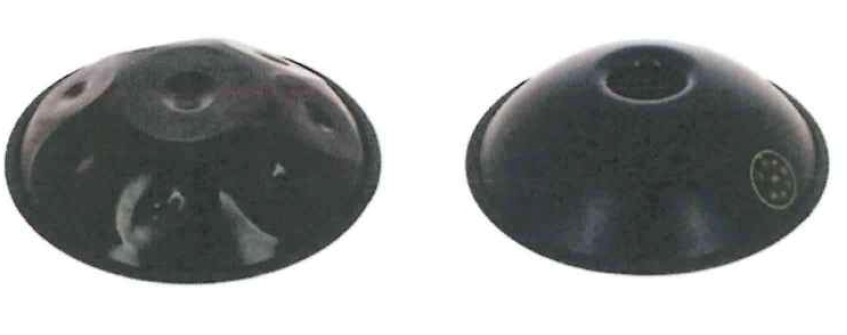
B.2) Mutant Layout: If the tone fields on the upper shell are arranged not merely in a circular pattern, but in what is known as a “Mutant Layout” (which breaks with the protected “circular arrangement of the tone fields around the central note”), then the copyright on the Hang© is NOT affected.
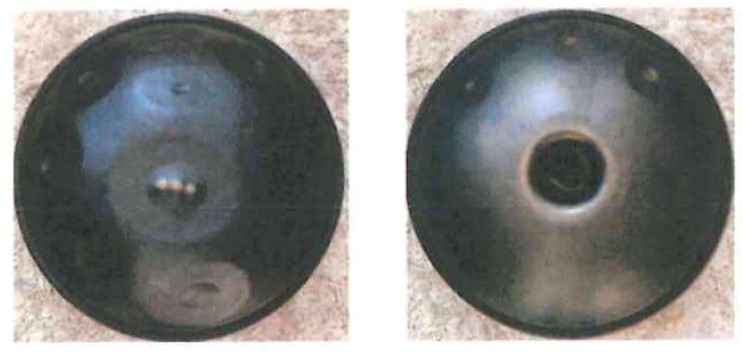
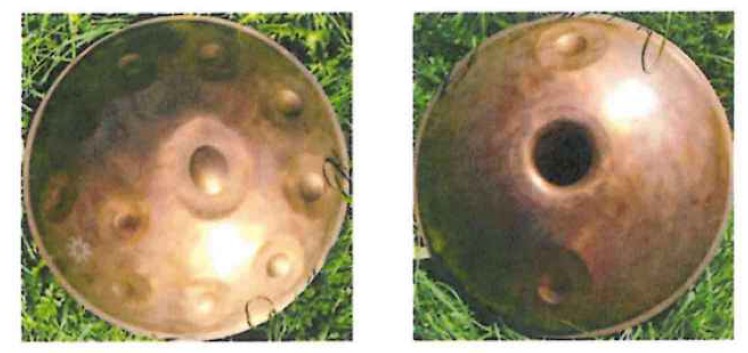
B.3) Double Ding: Two (or more) “central notes” break up the protected central and dome-shaped “central note form,” and therefore do NOT infringe on the copyright to the Hang©.
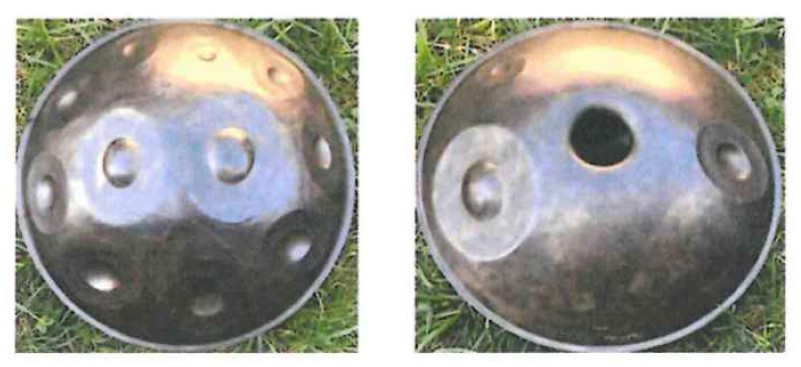
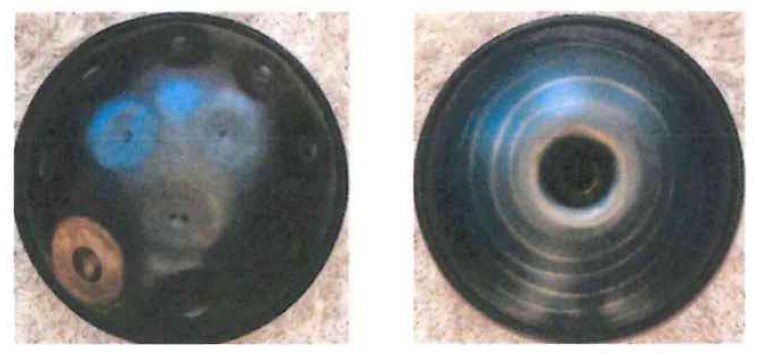
B.4) Bottom Notes: If these, or at least one of the bottom notes, is formed as the apex, copyrights are NO LONGER affected.
Links:
· Statement from PANArt, plus links to the court decision (original document in German and English – 142 pages)
· Statement from HCU, plus links to the court decision (original document in German and English – 142 pages)
The information presented on this website has been compiled to the best of our knowledge and belief—but in NO WAY does it claim to be absolutely accurate or complete!
A highly recommended statement on the subject can be found on the SHELLOPAN Website. Mattheu, the manufacturer of Shellopan handpans, describes his personal perspective on this legal dispute in a very well-reasoned and clear manner.
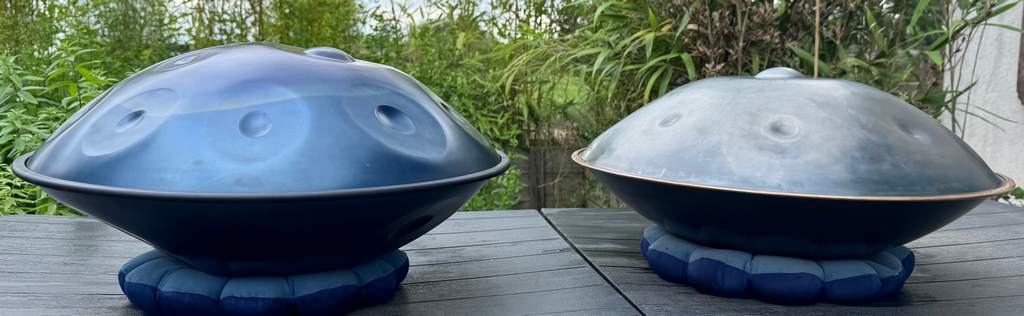
The original post was published in French.
PANIVERSE.ORG offers translated versions of his post, as of July 5, 2026, as PDF downloads via the following links:
Leave a Reply